No stock exchange listing. No CEO. No headquarters. Yet, few industries in history have generated hundreds of billions of dollars annually while surviving multiple governments’ attempts to dismantle them. The global illicit drug trade is estimated to be worth between US$426 billion and US$652 billion per year, roughly 1% of global GDP, rivaling the economic output of entire nations. Their impact is felt not only through chaos, but also through franchised violence, corruption and absolute power, their presence permeating the public and private sectors of major global economies. From centralized, hierarchical organizations to fragmented and intricate criminal enterprises, drug cartels became what we see today by the hands of government crackdowns, market competition, and the demand for flexibility in an increasingly globalized illegal economy.
Drug cartels are criminal organisations that facilitate the production and distribution of illegal narcotics. Most drug cartels are large, commercial operations that are highly organised, well financed, and usually involved in other criminal activities, such as human smuggling, trafficking, money laundering, and even terrorism. The USA has quickly grown to be a hotspot for such activities, with other less-developed and loosely regulated South American countries becoming ideal bases for such illicit operations.
In terms of production, cartels do not always directly grow or manufacture substances, but they control a wider supply chain. Plant-based drugs such as cocaine derived from coca plants are primarily cultivated in countries like Colombia, Peru, and Bolivia before being processed in hidden laboratories. In contrast, synthetic drugs such as methamphetamine and fentanyl are favoured and produced directly by cartels using imported chemical precursors, allowing for lower costs and higher production. By diversifying their sources and in-house production, cartels can strengthen their control in supply over the booming global drug market, comprising an estimated 117 million users of cocaine, opioids and amphetamines, up 28% in the last 10 years. (WB 2023)
The first drug cartel dated back to the 1970s where small amounts of cocaine had been smuggled from Colombia in suitcases to make their way to the United States. Exponential demand quickly prompted operational expansion, with the outrageous profit margins impossible to resist amid the backdrop of rising poverty and illiteracy in Columbia’s rural regions. As these operations expanded, cartels also required a steady labour force. Recruitment often targets economically vulnerable populations, particularly young individuals with limited access to education and employment. Many recruit through personal networks such as friends or family, while others are attracted by promises of fast income and upward mobility within the cartel hierarchies. In more extreme cases, coercion and violence are used, forcing individuals to participate in illegal activities.
Pablo Escobar, the infamous Colombian drug lord, led the Medellín Cartel from the late 1970s through the early 1990s, transforming a small-scale cocaine smuggling operation into a highly integrated criminal empire which at its peak earnt an estimated $420 million per week. He even famously offered to pay off his country’s entire US$10 billion debt in exchange for extradition exemption. His rule to rivals and officials was enforced through a simple statement: plata o plomo, that is bribe or death. Such ruthlessness and wealth earnt political influence, laying the foundation for the role these illicit empires would play within the public sectors of major economies.
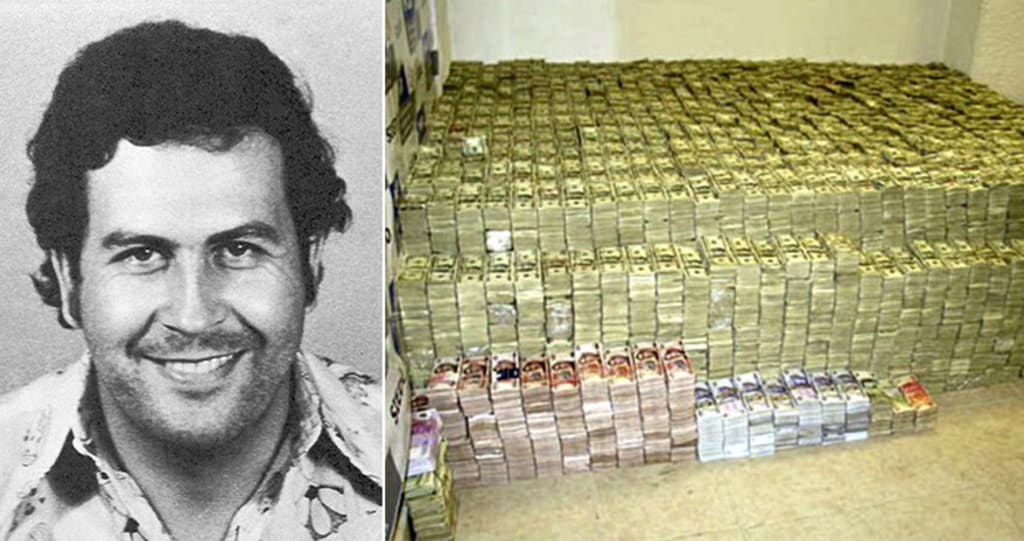
Escobar’s Medellin Cartel wrote off around US$2.1 billion annually simply because it was “lost” or “eaten by rats” (Source: Britannica)
When the U.S. launched a crackdown on Colombian drug exports in the early 1970s, Mexico emerged as the major player in the trade under two major groups: the Guadalajara Cartel and the Gulf Cartel. They became well-known among global trafficking networks and increasingly acted as intermediaries between South American producers and U.S. markets. Despite the U.S’s “success” with the “kingpin strategy” implemented by the DEA in the 1990s in eliminating the leaders of large cartels, either dead or alive, the drug competition still persists, and has since arguably even intensified. When the head of one cartel is removed, the organisation fragments into factions, all vying for power until someone comes and fills the gap, often with more efficient and cheaper distribution methods.
Building off the U.S crackdown on Central-American cartels in the 1970s through the “war on drugs” and the fragmentation of Pablo Escobar’s Medellin Cartel in the 1990s, the cocaine boom of the 1980s left a major demand gap in the global market for drug supply. While initial efforts succeeded in stopping the power and influence of cartels from Central America through the War on Drugs, the geographical location of Mexico allowed for easier access and innovation into the smuggling and production of drugs. Furthermore, regulatory incompetence led to Mexico’s debt crisis in 1982, where the labour market was deregulated and wages fell 31% between 1980 and 1998 (Jstor). A struggling macroeconomy coupled with booming demand for illicit drugs created the perfect storm for the rise of illegal cartels.
The lack of regulation and plummeting labour market wages and conditions, forced many civilians across the border to the United States, while those who remained were unable to resist the lucrative opportunities provided by the cartels. Bribe statistics from this period vary, however today’s figures highlight the cartel bribe influence remaining prominent in the Mexican economy, as “82.2% believe that acts of corruption, such as demanding bribes, are frequent.” (OCCRP) While 34% of public service users paid a bribe in 2025. (Trans)
The building blocks of the dominance in Mexican cartels such as Sinaloa aren’t an anomaly. When compared to different cartel powers around Mexico and Central America, there emerges a key pattern of institutional government weakness and extortionate demand for drugs in the U.S and E.U (IISS) driven by disproportionate wages and regulatory oversight. Cartels can make absurd margins by charging exceptional premiums to customers due to risk and the illegality of operations combined with cheap production costs. Major cartels in 2011 were said to earn between $25-$40 billion USD annually (Uni New Mex). The earnings potential for these organisations developed quickly and within the world of black-market business any person or opposing organisation was subject to violence. Resulting in over 30,000 crime-related deaths per year, with violent acts increasing significantly since the Mexican government officially declared war on criminal organizations in 2006 (cfr). The Mexican cartels are immense, not just from an economical perspective, but also sheer labour volume. In 2022 there were an estimated 160,000-185,000 cartel members in Mexico, which has now made cartels the 5th biggest employer in Mexico. (Gud)(Sci)
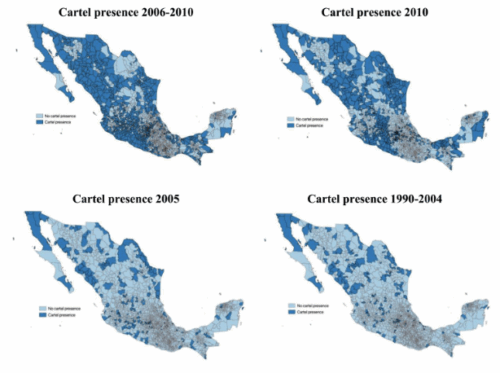
Cartels have rapidly expanded across Mexico (Source: Science Direct)
Mexican cartels have risen to significant prominence, with an estimated 20% of 2456 municipalities in Mexico having drug cartels operations before 2005, with this figure rising to 40% by 2010. The UN estimates that cocaine, methamphetamine and heroin trafficking generates $12.1 billion per year, while the U.S. Department of Homeland Security states that Mexican drug cartels generate $19-29 billion annually from US sales of all drugs. Cartels in Mexico employ over 450,000 people, with over 3 million Mexicans relying on cartels for a livelihood.
There are many different cartel groups within Mexico, with the existence of a couple of notable trafficking groups. Described by the US government as one of the world’s largest and oldest drug-trafficking organisations, the Sinaloa Cartel was founded in the 1980s and covers the north-west of Mexico, originating from the Guadalajara cartel. The United States Drug Enforcement Administration (DEA) investigations found an estimated tens of thousands of members in over 40 nations working under the cartel, with operations mainly involving trafficking drugs in a variety of transportation systems, such as speedboats, planes and submarines, primarily through Arizona and California. Alongside drug trafficking, where Sinaloa is one of the largest producers of fentanyl, the cartel also engages in various criminal activities, including money laundering, weapon trafficking, human smuggling, prostitution and extortion.The cartel was led by Joaquín Archivaldo Guzmán Loera (known as El Chapo), who rose to power in the Sinaloa Cartel in the 1990s until his arrest and extradition in 2016.
Sinaloa is estimated to make $3b a year through cross-border trade of Colombian cocaine, Mexican marijuana and methamphetamines. It has been estimated that the Sinaloa cartel controls approximately 40-60% of Mexico’s drug trade, with its power consolidated by numerous Mexican police and politicians on its payroll. Despite El Chapo’s arrest, the cartel still remains the largest US distributor of all Mexican cartels.
Other Mexican cartels include the Jalisco New Generation (CJNG), which was formed in 2010 and located in the west of Mexico. Considered to be the main rival to Sinaloa, their assets are thought to be worth over US$50b, placing them among the leading distributors of synthetic drugs while being instrumental in the amphetamine market. The CJNG is led by former police officer Ruben “El Mencho” Oseguera, who has become Mexico’s most wanted, with the US government offering a reward of US$15 million for information leading to his arrest or prosecution until he was killed in a military raid by the Mexican army on February 22 2026 following a series of key arrests in 2025. According to geopolitical analysis firm Stratfor, the CJNG is considered the fastest growing and most aggressive cartel in Mexico, launching attacks on security forces, public officials, such as in 2020 when they used grenades, RPGs, and rifles in Mexico City in an assination attempt on the head of the capital’s police force.
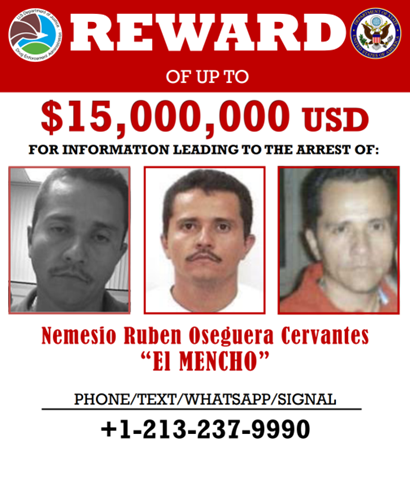
El Mencho’s Wanted Poster (Source: DEA)
Located in the north-east, the Gulf Cartel has existed since 1984, known for trafficking cocaine and marijuana into the US and collaborating with cartels in Colombia. In the 90s, the Gulf Cartel was reported to have brought in billions of dollars annually, with strong links to government and private sector corruption. In 1996, when their first leader Juan García Abrego was captured and imprisoned for life in the US, the new leader Osiel Cardenas Guillen emerged and expanded the cartel down a more violent path, even managing to recruit at least 31 ex-soldiers of Mexico’s Special Forces in 1997. Osiel was later arrested and sentenced to 25 years in jail in 2003, allowing his brother, Ezequiel, to take over who then died in a shootout in 2010. However following these events and internal conflict, a once significant group now ceases to exist, splitting into factions. Most notably, the armed forces would form the Los Zetas Cartel in 2010, which quickly rose to become one of the most prominent groups upon its inception thanks to their military backgrounds in technology and weaponry. This expertise in franchised violence and relentlessness catalysed their expansion across Mexico and even down south into Guatemala. The Zeta also developed significant networks across the world, allowing them to profit off their control of factions and infiltrate Velacruz and Tamaulipas state governments. However, after 2012 the Zetas were subject to leadership difficulties and deaths causing the cartel to diminish as quickly as they rose to prominence, now dependent on regional crime instead of drug trafficking.
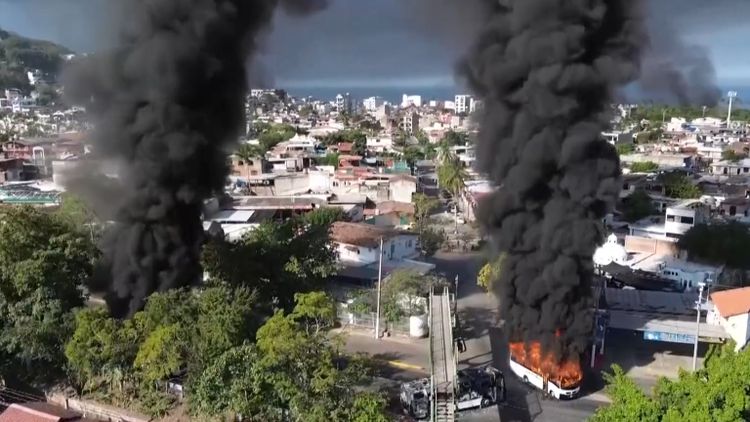
Cartel retaliation across Mexico as Druglord “El Mencho” was killed by American and Mexican Special Forces (Source: 9News)
While the cruelty and chaos of cartels remain front and centre, they ostensibly provide microeconomic benefits to individuals of Mexico. The employment rate in Mexico has averaged 96% for 20 years, however 56% of those are employed in the informal sector. Cartels are mainly able to recruit through exploiting the discrepancy in wages between formal and informal sectors. For example, in Iztapala formal sector employees earn MXN 8,910 per month while the formal sector earns MXN 4,450. Alongside high wages, the glamourising of cartel lifestyle and misinformation present on social media often encourages people to approach cartels themselves. Moreover, dropout rates are higher in cartel-dominated areas such as Sinaloa, where only 20% of people finish high school, coinciding with cartels being the fifth-largest employer in Mexico.
Even Escobar during his reign became known for his philanthropic efforts, earning him the nickname “Robin Hood” from everyday Colombians. He sponsored local soccer teams, built hospitals, stadiums, and housing for the poor, efforts which landed him a seat in Congress in 1982 before a campaign which exposed his criminal activities led by the Justice Minister forced him to resign. This minister was later assassinated.
However, these benefits do not translate to the economy as a whole. Research conducted by Queen Mary University of London found that cartels that operated without drug-related homicides did not derive benefits or reduction to poverty or unemployment levels. Additionally, the study found that while drug lords generate substantial profits, they do not benefit the local economies in which they operate. It was observed between 2003 and 2008, where 403 municipalities with drug-related homicides saw 35% less production and US$9.8b lost in production, as well as 17% less workers and 11% lower wages when compared to areas with no drug violence, not to mention the systematic corruption and ruthless killings.
Conclusion
Demand from major consumer markets such as the United States and Europe continues to drive production, while on the supply side, China has economic incentives to provide the chemical inputs necessary for new-age drug manufacturing. Longevity is fuelled by the incentives embedded within the global economy that sustain their operations, and the gaps both financially and socially left by the public sector in developing nations. Cartels have since grown from a few kilos in suitcases, to the major corporations embedded within global economies we see today. Despite a history of police reforms in Mexico (Jstor2), the widely adopted “war on drugs” and a widespread view that corruption needs to be addressed, there doesn’t seem to be any sign of cartels fading away.
Sources
https://www.unodc.org/documents/data-and-analysis/cocaine/Global_cocaine_report_2023.pdf?
https://www.unodc.org/unodc/en/data-and-analysis/the-cocaine-market.html?utm_source.com
https://www.dea.gov/sites/default/files/2024-05/5.23.2024%20NDTA-updated.pdf
https://www.ebsco.com/research-starters/law/drug-cartel
link.gale.com/apps/doc/A845719832/IFME?u=anon~cfcb1933&sid=sitemap&xid=e8e5b7a4
https://www.ibtimes.co.uk/why-are-sinaloa-cartel-worlds-most-powerful-gangsters-1465574
https://www.abc.net.au/news/2019-07-18/el-chapo-sentenced-to-life-behind-bars-in-us/11319564
https://edition.cnn.com/2016/08/18/americas/mexican-drug-cartels/
https://www.ice.gov/doclib/cornerstone/pdf/cps-study.pdf
https://www.abc.net.au/news/2026-02-23/cartel-boss-el-mencho-killed-by-mexican-army/106375040
https://insightcrime.org/mexico-organized-crime-news/gulf-cartel-profile/
https://www.bbc.com/news/world-latin-america-40480405 (BBC)
https://www.unodc.org/unodc/en/data-and-analysis/world-drug-report-2025-annex.html (World Bank)
https://www.rand.org/content/dam/rand/pubs/issue_papers/2007/IP300.pdf
https://www.jstor.org/content/oa_chapter_monograph/10.7249/tr906rc.11?seq=1 (Jstor) (Site actual paper not Jstor)
https://www.transparency.org/en/countries/mexico (trans)
https://www.occrp.org/en/news/mexico-companies-forced-to-budget-for-bribes-according-to-new-study (OCCRP)
https://www.sciencedirect.com/science/article/abs/pii/S0167629619303005 (Sci)
https://www.ebsco.com/research-starters/law/medellin-cartel (EBSCO)
https://digitalrepository.unm.edu/cgi/viewcontent.cgi?article=6344&context=sourcemex (Uni New Mex)
https://www.theguardian.com/world/2023/sep/21/mexico-cartels-fifth-largest-employer-study (Gud)
https://www.science.org/doi/10.1126/science.adh2888 (Sci)
https://www.jstor.org/content/oa_chapter_monograph/10.7249/tr906rc.11?seq=2 (Jstor2) (Site actual paper not Jstor)
https://www.cfr.org/global-conflict-tracker/conflict/criminal-violence-mexico (crf)
The CAINZ Digest is published by CAINZ, a student society affiliated with the Faculty of Business at the University of Melbourne. Opinions published are not necessarily those of the publishers, printers or editors. CAINZ and the University of Melbourne do not accept any responsibility for the accuracy of information contained in the publication.